
Sustainable clinical development — Think tank and project lab
Institutional Entrepreneurs (IEs) may be individuals, organisations or professions (professional networks, associations, social movements, professional communities, clubs, etc.). They are characterised by their ability to break with established patterns of behaviour and to adopt reflexive positions with a view to changing the institutional environment (DiMaggio, 1988; Dorado, 2005; Hardy and Maguire, 2008; Leca and Naccache, 2006).
They are therefore actors whose aim is to change the rules of the game by transposing existing practices, beliefs and models (Leca and Naccache, 2006).
Institutional creation work consists of putting in place new practices, new routines and new standards. This work covers operations aimed, at the same time, at securing legitimacy for these new practices in the eyes of stakeholders. However, their recognition “leads them to confront the paradox of the embedded agent (situated action) within its institutional environment” (Leca and Naccache, 2006). Are institutional entrepreneurs not actors to be considered in the upheaval of regulatory, normative and cognitive systems?
Several empirical studies have sought to understand the mechanisms and effects that underlie these activities (Hardy and Maguire, 2008). This is the case of the reconstitution of the European Union (Fligstein, 2001).
We have identified institutional entrepreneurs in our field of study:
“Not all institutions are concerned by institutional work. For actors to be able to decide to create, challenge or maintain an institution, it must be clearly identified as a social construct that can be put in place or called into question through strategic action” (Slimane and Leca, 2010).
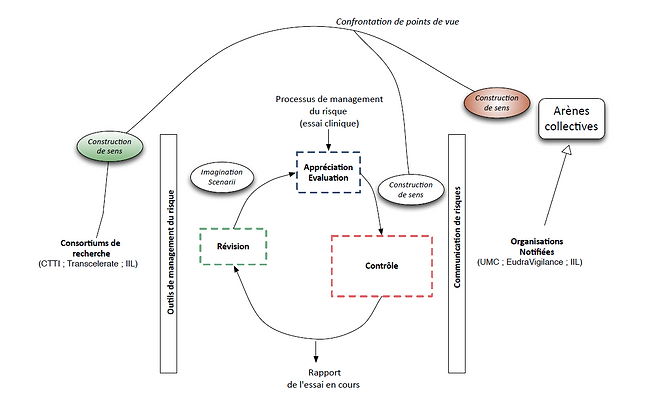
As part of action research, we are attempting an entrepreneurial experiment: we are setting up a community of practice in the field, whose purpose is to define the notion of “ethical risk” in clinical development; to assess compliance with the regulations and standards in force; to carry out a feasibility study for the introduction of health “watchers”; and to develop a proposal for rating the risk of clinical trials (the principle of actuarial science).
This epistemic and professional community, which we refer to under the brand “Intelligence In Life” (IIL), is a collaborative space (think tank and project lab) that brings together: researchers and designers of health products (both medicinal and non-medicinal); experts in regulations and standards; patient committees; academics in the humanities and social sciences; experts in financial and insurance risks; and invited representatives of the legitimate institutions and competent authorities.
The work undertaken aims to provide a scientific foundation for the emergence of new tools for safety-oriented strategic monitoring in the field of clinical development of health products. At the epistemological level, from a stance of engineering constructivism, we question the field with a determination to transform the traditional modes of response in the context studied. We hope to develop a model or, at the very least, to enrich existing models, through co-construction in the field on the one hand, and feasibility on the other (Le Moigne, 1995).
This therefore does not rule out critical realism: we are probably able to interpret the positions of actors, and even of stakeholders, through our interactions during field studies, while postulating that there are limits perceived a priori:
Is it possible to create meaning through a process of collective intelligence that goes beyond the walls of the company producing the health products, and thus to bring about a process of strategic monitoring (Amabile, 1999) at the level of the stakeholders (sponsoring laboratories, CROs, health authorities)? Will this process (Arena et al., 2015) be capable of preventing serious adverse events affecting patient-subjects? And also of detecting, preventing or attesting to fraud or misconduct in unethical trials, and thus of keeping the clinical research approach within an “acceptable safety envelope”? This is the safety challenge facing industries and the healthcare system by 2030, in which we wish to take part through this fundamental research.
In the constructivist perspective, however, norms rarely impose themselves on States through the force of their intrinsic legitimacy. The role of “norm entrepreneurs” is considered decisive, whether they are international organisations, NGOs or other transnational networks.
Margaret Keck and Kathryn Sikkink in particular highlighted the role of networks structured around a cause (transnational advocacy networks) made up of actors from NGOs, social movements, foundations, the media, churches, trade unions, intellectuals, international organisations and governments (Keck and Sikkink, 1998). The two authors show in particular how, in authoritarian States, social movements lacking any means of expression vis-à-vis their government join forces with transnational networks that support their cause. Authoritarian governments are then subjected to international pressure (a “boomerang” effect of their repressive policy) that reinforces the effect of internal mobilisation, with the aim of changing the attitude of these governments and leading them to internalise new democratic norms. In the longer or shorter term, authoritarian regimes would thus be led to convert to human rights norms, under the effect of a twofold normative pressure, internal and international.
Cass Sunstein (Sunstein, 1997) identifies a category of people, whom he calls norm entrepreneurs, who are interested in the evolution of social norms. If their efforts succeed, this can trigger a cascade that gradually leads to substantial changes in the social norms of an entire society. Norm entrepreneurs can exploit widespread dissatisfaction with existing norms and thus move society towards a new norm in several ways: (A) by signalling their own commitment to wanting to change norms, (B) by building coalitions, (C) by challenging the norms that appear least costly, (D) by making compliance with the new norms seem more advantageous. These norm entrepreneurs investigate the problem in all its dimensions, thereby giving it a mobilising “cognitive frame” (Keck and Sikkink, 1998).
Society can thus undergo a rapid revision of its prevailing norms. In this work on norms, the symbolic dimension then proves decisive. The two authors take the example of the mobilisation of human rights organisations which, in the 1970s and 1980s, brought the issue of female genital mutilation in Africa out of its anthropological and medical confidentiality in order to frame it as a human rights issue.
Norms can also be produced by networks of professionals with scientific expertise in particular areas of international public policy, in other words transnational epistemic communities (Haas, 1992). For Haas, an epistemic community is “a network of professionals with recognised expertise and competence in a particular domain and an authoritative claim to policy-relevant knowledge within that domain” (Haas, 1992).
According to Haas, epistemic communities have:
Epistemic communities are distinguished from other transnational interest groups by the specificity of their activity, which is oriented towards the production of scientifically validated and falsifiable knowledge. Many examples of transnational epistemic communities can be found in a variety of fields of expertise (IPCC climatologists, epidemiologists at the WHO, nuclear experts at the IAEA, etc.).
Haas’s fundamental idea is that an epistemic community is both a community of knowledge and a community of power. Dedicated to reducing uncertainty in decision-making at the international level, these communities would indeed have acquired a power of their own: “Members of transnational epistemic communities can influence state interests either by directly identifying them for decision-makers or by illuminating the salient dimensions of an issue from which the decision-makers may then deduce their interests” (Haas, 1992).
Even though the notion has enjoyed great success that has largely spilled beyond the constructivist paradigm, Haas originally claimed to follow a “limited constructivism” that emphasised the cognitive dimension of international politics, independently of the logics of power and interest. An approach to our research field within an episteme of the “engineering constructivism” type seems to us compatible with this field of institutional, or more precisely neo-institutional, entrepreneurship.
In this theoretical light, our entrepreneurial experiment “Intelligence in Life, for sustainable clinical development” takes on the aspect of an epistemic community. The pragmatic acceptance of this Gordian knot between law and economics, in pursuit of an objective of safety for HROs, should probably lead them towards polycentrism in decision-making and therefore in responsibility — in order to establish a reasonable solution according to a majority authority or, failing that, the advice of all the stakeholders involved in the dispute. This has the virtuous consequence of strengthening cooperation and trust (of shareholders, of the principal’s insurers, of the sponsor).
Finally, this co-evolution of institutions and the economy interacts with technology (including information and communication technology) and with social and ethical change. Can we not question the specificity that characterises the medicinal product in the broad sense (generic, market, consumer, etc.)? Is this specificity not also found in the regulation of the field to which it belongs? In other words, is there not a specificity of pharmaceutical regulation?
The CPPs (Comités de Protection des Personnes, or Personal Protection Committees) are tasked with giving an opinion on research projects involving the human person (RIPH), with particular regard to the protection of the persons taking part in the research. The opinion of the CCPPRBs was advisory; the opinion of the CPPs amounts to an authorisation, meaning that research cannot be started following an unfavourable opinion from a CPP. The CPPs are also asked to give an opinion on projects to use elements and products of the human body for scientific purposes during RIPH, or that are subject to a change of purpose.
The composition of the CPPs, the appointment of members, the organisation and operation of the body, and the opinion procedure are defined in the French Public Health Code. The members of the first CCPPRBs, established in 1991, and in particular their chairs, wished from 1992 onwards to come together in a Conférence Nationale des Comités de Protection (CNCP), created sui generis.
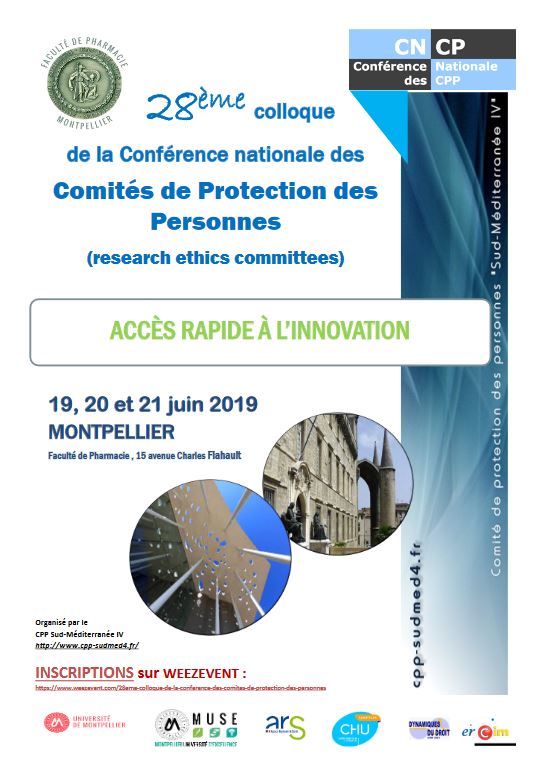
28th symposium of the Conférence nationale des Comités de la Protection des Personnes — 19, 20, 21 June 2019, Faculty of Pharmacy, Montpellier.
Academic and industrial development in clinical research and information systems (RBM-oriented). Promotion of a new approach to risk-based monitoring, pharmacovigilance and surveillance. Clinical expertise, legal representation and case follow-up.
Examples of the type of studies carried out and the scope of responsibilities:

Recent accidents have made the public aware of the need for transparency and safety in the evaluation of health products. The case of VIOXX® can be identified as the most representative global, contemporary, industrial pharmaceutical accident, similar to that of thalidomide in 1953 and Distilbène in 1977.
This work focuses on one of today’s societal questions: how to guarantee every citizen the quality and safety of the health products available on the market? This subject is directly linked to the notion of pharmacovigilance and, more broadly, to strategic monitoring and foresight (SF).